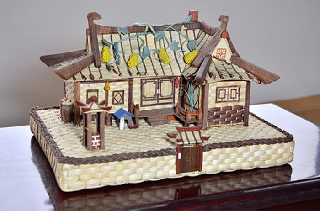
National Intangible Cultural Heritage: Grass Handicraft
Korean people have long made and used different kinds of daily necessities and ornaments with various grass materials, stems, leaves and bark from trees.
They called this grass handicraft.
Grass handicraft boasts of the longest tradition among folk crafts, developed and enriched in close connection with the people’s economic and cultural activities.
As it didn’t need any specialized equipment or tools, plus abundant raw materials, grass handicraft was a popular and relatively easy craft.
Unlike ceramics and metalwork, grass handicraft can easily go bad and it is difficult to preserve it for a long time.
However, a reed mat piece unearthed in Namgyong Site, Honam-ri, Samsok District, Pyongyang is relatively well-preserved as a time-honoured historical relic.
Originated in the ancient times of the earliest period of human society (30th century B.C.-3rd century B.C.), grass handicraft had steadily developed by virtue of people’s creative activities till the period of Koryo dynasty (918-1392 A.D.).
During this period, such materials as sedge, bush clover, reed, osier, rice straw, hemp and arrowroot were used to make baskets, mesh bags, winnows, straw sandals, ropes, strings, kat(a kind of Korean hat)nets and other products.
By the period of the feudal Joson dynasty (1392-1910 A.D.), grass handicraft enjoyed its heyday thanks to the resourceful talent and creative activities of the working people and its mainstream products were sedge crafts.
Modern grass handicraft now enjoys popularity and is steadily developing.